Understanding the Population Dynamics of Hypertension through Simulations and Control Approaches
Keywords:
Hypertension, optimal control, population dynamics, mathematical modelling, Pontryagin’s Maximum PrincipleAbstract
Hypertension, also known as high blood pressure, remains a rising global public health concern, particularly in low-and middle-income countries, affecting an estimated 1.39 billion people worldwide and contributing substantially to preventable mortality when inadequately controlled. In this study, we developed a mathematical model based on optimal control theory to evaluate the impact of intervention strategies on the population dynamics of hypertension. A compartmental framework is employed to classify individuals into non-hypertensive, hypertensive without complications, and hypertensive with complications groups. The model incorporated a general control variable representing combined interventions, including lifestyle modification, health screening, and medication. The optimal control problem is solved using the Forward-Backward Sweep method combined with a fourth-order Runge-Kutta algorithm. Numerical simulations suggested that the optimal control strategy reduces hypertension prevalence by approximately 24% and slows the progression to complications by about 3% over ten years. Lower control weightage value allows more aggressive interventions, while higher weightage penalize control intensity and lead to an expansion of the complication group. Additionally, high adherence levels (ξ = 0.80 and ξ = 0.95) are shown to be vital for successful outcomes, whereas low adherence (ξ = 0.50) reduces the effectiveness of control measures notably.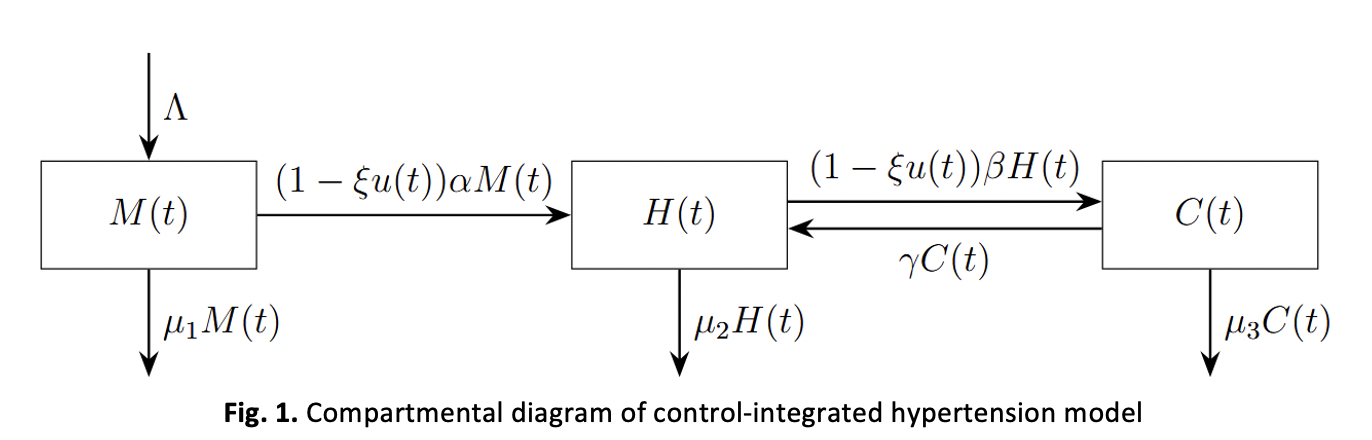
Downloads
Published
2026-06-07
How to Cite
Hanis Nasir, Takashi Suzuki, Rashidah Tukiran, & Noorehan Yaacob. (2026). Understanding the Population Dynamics of Hypertension through Simulations and Control Approaches. Warisan Journal of Mathematical Sciences and Engineering , 4(1), 1–13. Retrieved from https://warisanunggul.my/index.php/wjmse/article/view/19
Issue
Section
Articles